High-Strength Steel Application in Transmission Tower Manufacturing

A Deep Technical Analysis of Transmission Line Tower Manufacturing Standards
December 10, 2025
Global Transmission Line Tower Industry Technical Analysis
December 16, 2025
The Ascendancy of Strength: A Deep Technical Analysis of High-Strength Steel Application in Transmission Tower Manufacturing
The infrastructure of modern electrical power transmission is perpetually driven by the need for greater efficiency, longer spans, and reduced environmental impact, a trifecta of engineering challenges that traditional, ubiquitous mild structural steel (like $\text{Q235}$ or $\text{S275}$) is increasingly unable to resolve economically. This drive has necessitated the strategic and complex incorporation of High-Strength Steel (HSS) into transmission line tower design and manufacturing. HSS, characterized by a minimum yield strength ($\text{R}_\text{e}$) typically exceeding $355 \text{ MPa}$ and often reaching $460 \text{ MPa}$ or $550 \text{ MPa}$ in modern lattice structures, is not merely a stronger version of its mild steel predecessor; it represents a fundamental shift in material science, structural design philosophy, and manufacturing rigor. The technical analysis of its application must move beyond simple weight savings to address the cascading technical complications it introduces across the entire fabrication lifecycle—from the esoteric requirements of its metallurgy and processing (like the $\text{Thermomechanical Controlled Process}$ or $\text{TMCP}$) to the stringent, often non-traditional demands of hole making, corrosion protection, and final assembly tolerance. HSS is a tool that grants engineers immense structural leverage, allowing for massive power line spans over challenging terrain or the construction of ultra-high voltage ($\text{UHV}$) towers that stand as slender giants, but this leverage comes with a non-negotiable demand for ultra-precise control over every manufacturing variable, transforming the fabrication shop from a heavy industry environment into something approaching a precision engineering laboratory.
The Metallurgical Mandate: Achieving High Strength Through Microstructure Control
The initial, and perhaps most technically fascinating, aspect of utilizing HSS lies in understanding how its elevated strength is achieved without sacrificing the necessary ductility and, critically, the weldability required for modern construction, even though towers are predominantly bolted. Traditional mild steel relies on a simple $\text{Ferrite-Pearlite}$ microstructure, with strength derived primarily from the relatively high Carbon ($\text{C}$) content. However, increasing $\text{C}$ content, while enhancing strength, dramatically raises the $\text{Carbon Equivalent}$ ($\text{C}_{\text{eq}}$), leading to poor toughness, increased susceptibility to brittle fracture, and near-impossible field weldability—a severe liability for repairs. HSS circumvents this problem through sophisticated metallurgical techniques, primarily Micro-Alloying and the Thermomechanical Controlled Process (TMCP).
Micro-alloying involves adding minute quantities (typically less than $0.1\%$) of elements like Niobium ($\text{Nb}$), Vanadium ($\text{V}$), and Titanium ($\text{Ti}$). These elements form extremely fine, stable carbonitrides during the rolling and cooling process. These precipitates act as potent obstacles to dislocation movement and, more importantly, are crucial for grain refinement. The $\text{TMCP}$ controls the rolling temperature and the cooling rate with meticulous precision, ensuring the steel achieves a fine-grained microstructure, often $\text{Bainitic}$ or fine $\text{Acicular Ferrite}$, instead of the coarser $\text{Ferrite-Pearlite}$ structure of mild steel. According to the $\text{Hall-Petch}$ relationship, a finer grain size directly correlates to higher yield strength. The standards governing HSS production (e.g., $\text{EN S460}$ or $\text{GB Q460}$ and $\text{Q550}$) are therefore heavily focused on specifying the minimum strength while simultaneously imposing strict upper limits on the $\text{C}_{\text{eq}}$, typically keeping it below $0.43\%$ for good weldability, ensuring that the strength is derived from microstructural control (grain refinement and precipitation hardening) rather than brute $\text{Carbon}$ content. This careful, almost alchemic balance ensures the HSS member has the immense load-bearing capacity required for high-stress legs in $\text{UHV}$ towers, while still possessing the necessary fracture toughness ($\text{Charpy V-notch}$ impact energy testing is a critical requirement) to withstand dynamic loads in cold environments. The application of HSS is thus inseparable from the stringent manufacturing control applied at the steel mill, as the integrity of the final structure is fundamentally dependent on this engineered microstructure.
The Fracture Point: Fabrication Challenges and the Shift from Punching to Drilling
The inherent strength of HSS, derived from its refined microstructure, introduces significant and complex technical challenges during the fabrication phase, particularly concerning hole making and cutting. In the manufacture of traditional mild steel towers, high-speed punching is the preferred, cost-effective method for creating bolt holes. Punching, however, is a shearing operation that creates a zone of severely cold-worked, strain-hardened material immediately adjacent to the hole’s edge, often accompanied by micro-tears or cracks initiated by the punching tool. For mild steel ($\text{Q235}$), the ductility is high enough that this work-hardened zone is generally tolerable.
In HSS (e.g., $\text{Q460}$ and above), the low ductility that accompanies high strength makes the material acutely sensitive to this localized cold working. The highly strained zone around a punched hole in HSS becomes a severe stress concentration factor and a potential initiation site for fatigue cracks or, critically, brittle fracture, especially under the low temperatures often experienced by transmission towers. The manufacturing standard for HSS tower fabrication must therefore impose strict mandates that fundamentally alter the process. Many international specifications (including client-specific standards for $\text{UHV}$ projects) often prohibit or severely restrict punching of HSS members thicker than a certain gauge (e.g., $10 \text{ mm}$), mandating the exclusive use of drilling.
Drilling, in contrast to punching, is a controlled cutting process that minimizes the extent of plastic deformation and micro-cracking at the hole periphery, preserving the designed properties of the $\text{TMCP}$ material. Where punching is unavoidable for very thin HSS sections, the standard often requires that the punched hole must be subsequently reamed to a larger diameter. This reaming process serves to mechanically remove the thin ring of severely damaged, strain-hardened material from the shear-affected zone, mitigating the risk of fatigue crack initiation. This shift from high-speed, low-cost punching to slower, precision drilling or reaming is a pivotal technical condition in HSS tower manufacturing. It necessitates a significant capital investment in $\text{CNC}$ drilling machinery and fundamentally increases the manufacturing time per ton of steel, a trade-off accepted only because the structural integrity of the final product hinges on eliminating these potential brittle fracture sites. The dimensional accuracy standard is also heightened here; as the members are thinner due to the material strength, any geometric imperfection or misalignment in hole placement poses a greater relative threat to the stability of the entire structure. The interplay between material properties and fabrication technique is stark: the benefit of HSS’s strength can be entirely negated by a single, poorly formed bolt hole, emphasizing the need for manufacturing standards that are tailored specifically to the metallurgical characteristics of the higher-grade steel.
| Steel Grade (Example) | Minimum Yield Strength (Re) | Typical Carbon Equivalent (Ceq) | Recommended Hole Making Method (Standard Requirement) | Primary Manufacturing Risk |
| Mild Steel ($\text{Q235}$ / $\text{S275}$) | $235 \text{ MPa}$ | $\approx 0.35$ | Punching (Standard Practice) | Minor localized strain hardening, manageable |
| High-Strength ($\text{Q460}$ / $\text{S460}$) | $460 \text{ MPa}$ | $\le 0.43$ | Drilling or Reaming Post-Punching | Brittle fracture, fatigue initiation at shear edge |
| Very High-Strength ($\text{Q550}$ / $\text{S690}$) | $550-690 \text{ MPa}$ | $\le 0.45$ | Drilling Only (Often Mandated) | Hydrogen Embrittlement susceptibility, high cost |
The Paradox of Slenderness: Design Optimization and Stability Control
The primary structural benefit of HSS is the ability to reduce the cross-sectional area of the tower members while maintaining the required tensile and compressive strength. If the yield strength is doubled (e.g., from $235 \text{ MPa}$ to $470 \text{ MPa}$), the member size can theoretically be halved. However, this optimization immediately shifts the structural design constraint from Strength Limit State (yield) to Stability Limit State (buckling). Transmission tower legs and bracing are typically long, slender compression members, and their structural capacity is often governed by Euler buckling, which is highly sensitive to the slenderness ratio ($\text{L}/\text{r}$), where $\text{L}$ is the unbraced length and $\text{r}$ is the radius of gyration. When HSS allows for thinner, smaller-section members, $\text{r}$ decreases significantly, pushing the $\text{L}/\text{r}$ ratio higher.
The manufacturing standard must respond to this paradox of slenderness by demanding an even more rigorous control over geometric perfection and straightness. For a mild steel angle, a slight bow or crookedness may be tolerable because the member is thick and its strength reserve is high. For a highly optimized HSS member, any manufacturing deviation from perfect straightness creates an immediate and amplified eccentricity, leading to premature bending and localized stress concentrations that trigger buckling at a load far below the theoretical capacity. The standard for Maximum Deviation from Straightness must therefore be tightened considerably for HSS members compared to general structural specifications. For instance, while $\text{AISC}$ specifications might allow a deviation of $\text{L}/960$ for general construction, HSS applications in tower construction often demand tighter tolerances, sometimes $\text{L}/1000$ or better, for critical compression legs.
This increased demand for straightness impacts every stage of the manufacturing process: from careful, low-stress handling and storage of the raw steel to the need for post-fabrication straightening or tension leveling processes. The standard must specify the acceptable methods for corrective action, often preferring mechanical means over localized heating, as uncontrolled thermal processes can compromise the carefully engineered $\text{TMCP}$ microstructure, potentially destroying the high yield strength achieved in the mill. The paradox dictates that the very property that makes HSS desirable (its high strength leading to slenderness) also imposes the most exacting demands on the manufacturing process’s ability to maintain geometric control, linking the cost-saving benefits of the material directly to the cost-increasing requirement for precision fabrication.
The Corrosive Dilemma: Hot-Dip Galvanizing and Hydrogen Embrittlement Risk
The application of HSS introduces a profound technical dilemma in the corrosion protection phase, which for transmission towers is almost universally Hot-Dip Galvanizing ($\text{HDG}$). $\text{HDG}$ requires thorough surface preparation, which involves acid pickling (immersion in hydrochloric or sulfuric acid) to remove mill scale and rust. This pickling process is an electrochemical reaction that generates atomic hydrogen ($\text{H}$) on the steel surface. In traditional mild steel, the $\text{H}$ atoms are largely liberated into the atmosphere or diffuse out harmlessly. However, HSS, particularly grades with $\text{R}_\text{e}$ above $500 \text{ MPa}$, is highly susceptible to Hydrogen Embrittlement ($\text{HE}$).
The complex, finer microstructure of HSS—the same microstructures that grant its high strength—contains an increased density of internal “traps” (grain boundaries, dislocation sites, non-metallic inclusions) where the nascent hydrogen can collect. The presence of this trapped hydrogen, combined with the tensile stresses inherent in the installed tower, can lead to catastrophic, delayed brittle fracture, often hours or days after fabrication or even years after erection, especially for critical fasteners or heavily stressed tower legs.
The manufacturing standard must address this risk through extremely specific and rigorous technical conditions:
-
Controlled Pickling Protocols: The use of Acid Inhibitors in the pickling bath is often mandated to reduce the rate of hydrogen evolution without compromising cleaning efficiency. The standard must also specify a strict maximum immersion time—shorter than that used for mild steel—to limit hydrogen absorption.
-
Mechanical Surface Preparation: For the highest strength grades (e.g., $\text{Q550}$ and $\text{Q690}$), the standard may require the complete substitution of acid pickling with mechanical cleaning methods, such as controlled $\text{Shot Blasting}$ or $\text{Grit Blasting}$, which physically remove the surface contaminants without generating hydrogen.
-
Post-Treatment Baking: While controversial and not universally adopted, some standards may require a low-temperature baking process after galvanizing, specifically for critical fasteners, to encourage the effusion (diffusion out) of absorbed hydrogen from the steel lattice.
-
Fastener Coating Alternatives: For high-strength bolts ($\text{A490}$ or $\text{ISO 10.9}$), the risk of $\text{HE}$ is so high that $\text{HDG}$ is sometimes completely prohibited by the manufacturing standard. Alternative, non-electrochemical coatings, such as zinc-rich inorganic paints or mechanical galvanizing, are mandated instead, accepting the higher coating cost for the sake of avoiding brittle failure.
This deep technical consideration of $\text{HE}$ is a non-negotiable part of the HSS manufacturing specification. It adds complexity and cost to the $\text{HDG}$ process, but it is the necessary consequence of choosing a material whose microstructure, while strong, interacts dangerously with a key corrosion protection step. The structural integrity of a tower is a function of both its inherent strength and its durability against the environment; sacrificing the latter for the former, even inadvertently, is a fatal error that the manufacturing standard must explicitly prevent.
Economic Rationale and Life Cycle Cost Analysis
The justification for using HSS in transmission tower manufacturing ultimately rests on a compelling Economic and Life Cycle Cost Analysis, which the technical specifications indirectly support. The initial material cost of HSS (e.g., $\text{Q460}$) is significantly higher than mild steel (e.g., $\text{Q235}$), sometimes $30\%$ to $50\%$ more per tonne. However, the application of HSS triggers a cascading series of cost reductions across the project lifecycle that, when analyzed holistically, often makes it the more economical choice for large-scale, $\text{UHV}$, or remote projects.
The key economic leverages driven by HSS are:
-
Weight Reduction and Logistical Savings: A structure designed with $\text{Q460}$ steel can achieve weight reductions of $15\%$ to $30\%$ compared to a $\text{Q235}$ tower of equivalent capacity. This translates directly into substantial savings in transportation (freight) costs, especially crucial for towers in inaccessible mountain or remote regions. Fewer truckloads are required, reducing logistical complexity, road construction, and the associated environmental disturbance.
-
Foundation and Erection Costs: A lighter tower imposes lower overall dead loads and wind loads on the foundation. This permits the use of smaller, less material-intensive foundations (e.g., smaller concrete grillage or direct embedment depths). Given that foundation work often accounts for a significant portion of the total tower cost (sometimes $20\%$ to $30\%$), the savings here can offset the higher material cost of the HSS itself. Furthermore, lighter members require less heavy lifting equipment and facilitate faster, safer erection times.
-
Environmental and Embodied Carbon Footprint: The manufacturing specifications increasingly intersect with environmental standards, requiring the consideration of Embodied Carbon ($\text{eCO}_2$). Since the steel volume is reduced by $15\%-30\%$, the embodied energy and carbon emissions associated with steel production are lowered commensurately. This long-term environmental benefit is becoming a critical financial and regulatory factor in large public infrastructure projects.
The manufacturing specifications, by dictating the processes (drilling, controlled galvanizing) that ensure the HSS performs as designed (i.e., at its $460 \text{ MPa}$ yield strength), are the non-financial conditions that validate the economic model. Without guaranteed manufacturing quality, the structural optimization (the weight reduction) is based on a false premise, and the entire economic rationale collapses. Therefore, the higher cost of manufacturing HSS, necessitated by the drilling and specialized galvanizing protocols, is fundamentally a cost of risk mitigation and performance assurance, which, when coupled with the logistical savings, justifies the material choice.
Case Studies, UHV Applications, and Future Research Directions
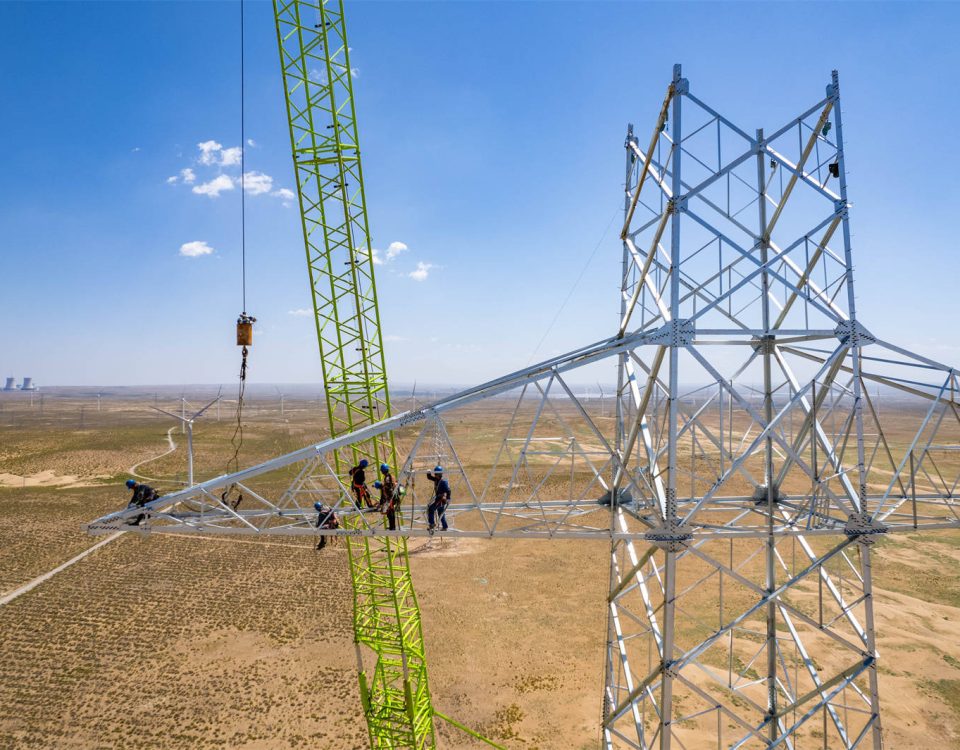
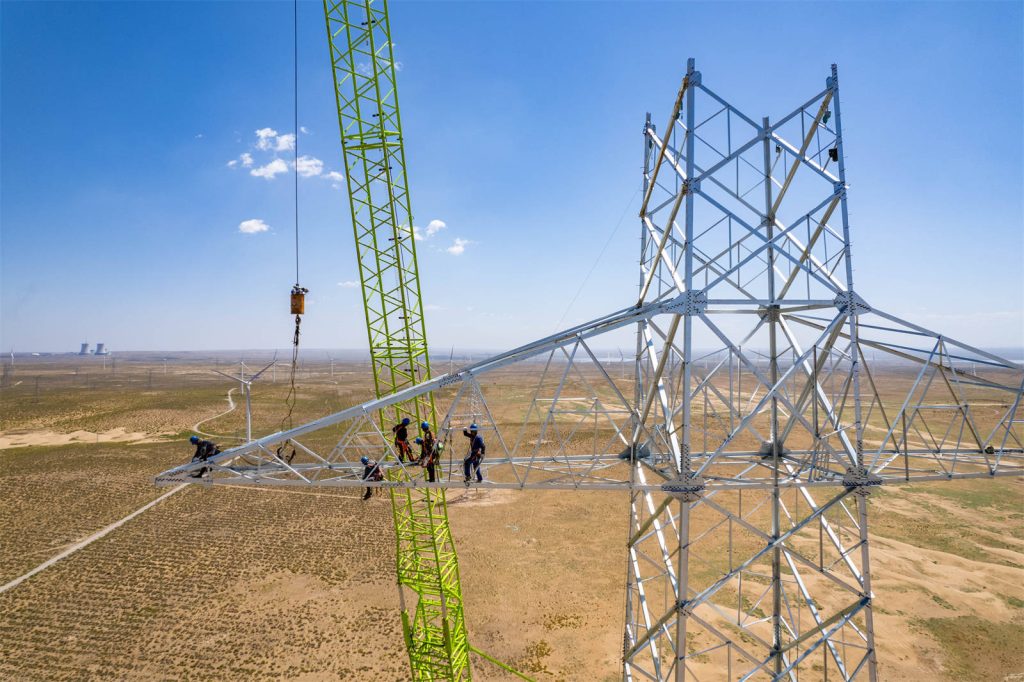
The most compelling real-world application of HSS technology is in Ultra-High Voltage ($\text{UHV}$) transmission lines (e.g., $1000 \text{ kV}$ AC or $\pm 800 \text{ kV}$ DC) and in special river-crossing or gorge-spanning towers. In $\text{UHV}$ lines, the transmission conductors are extremely heavy, and the towers must be exceptionally tall to ensure adequate ground clearance. These requirements translate into immense compressive and tensional forces in the main tower legs and cross-arms, making HSS (grades $\text{Q460}$ and $\text{Q550}$) not just an economic choice, but a technical necessity. Without the strength-to-weight ratio provided by HSS, these massive towers would become structurally and logistically unfeasible, demanding excessively heavy mild steel members that would complicate construction and overwhelm the logistical chain.
Future research and development are pushing HSS application further, focusing on:
-
Wider Adoption of Grade $\text{Q690}$ ($\text{R}_\text{e} \approx 690 \text{ MPa}$): Currently limited by cost and extreme fabrication difficulty, the technical specifications are evolving to safely incorporate these grades, which demand even more stringent $\text{TMCP}$ control and almost certainly prohibit all acidic processing due to $\text{HE}$ risk.
-
Hybrid Structures: Integrating $\text{HSS}$ for critical, highly stressed components (like the main legs and critical bracing) with standard mild steel for less-stressed members (like horizontal frames and secondary bracing). This requires the manufacturing standard to clearly define material segregation, handling protocols, and joint detailing for dissimilar materials, ensuring no galvanic corrosion occurs where the two materials meet.
-
Additive Manufacturing (AM) for Joints: While lattice towers are bolted, the use of $\text{AM}$ (3D printing) for complex, load-transferring joints is being investigated to optimize geometry and further reduce weight, demanding entirely new material standards for the performance and certification of additively manufactured structural steel.
The journey of HSS in transmission tower manufacturing is a continuous feedback loop between material science, engineering design, and fabrication rigor. The manufacturing standard stands as the critical document that translates the high performance achieved in the steel mill into a reliable structural reality on the transmission line. It is a constantly evolving record of technical solutions to the unique problems posed by a material that is pushing the limits of structural efficiency, demanding higher standards of precision, control, and accountability at every step.