Monopole Telecommunication Antenna Tower | 25m HDG Steel Technical Specs & Engineering Analysis
Overhead Transmission Line Tower Structure & Foundation Design Research
May 5, 2026
Hot Dip Galvanized Steel Lattice Power Transmission Tower
July 13, 2026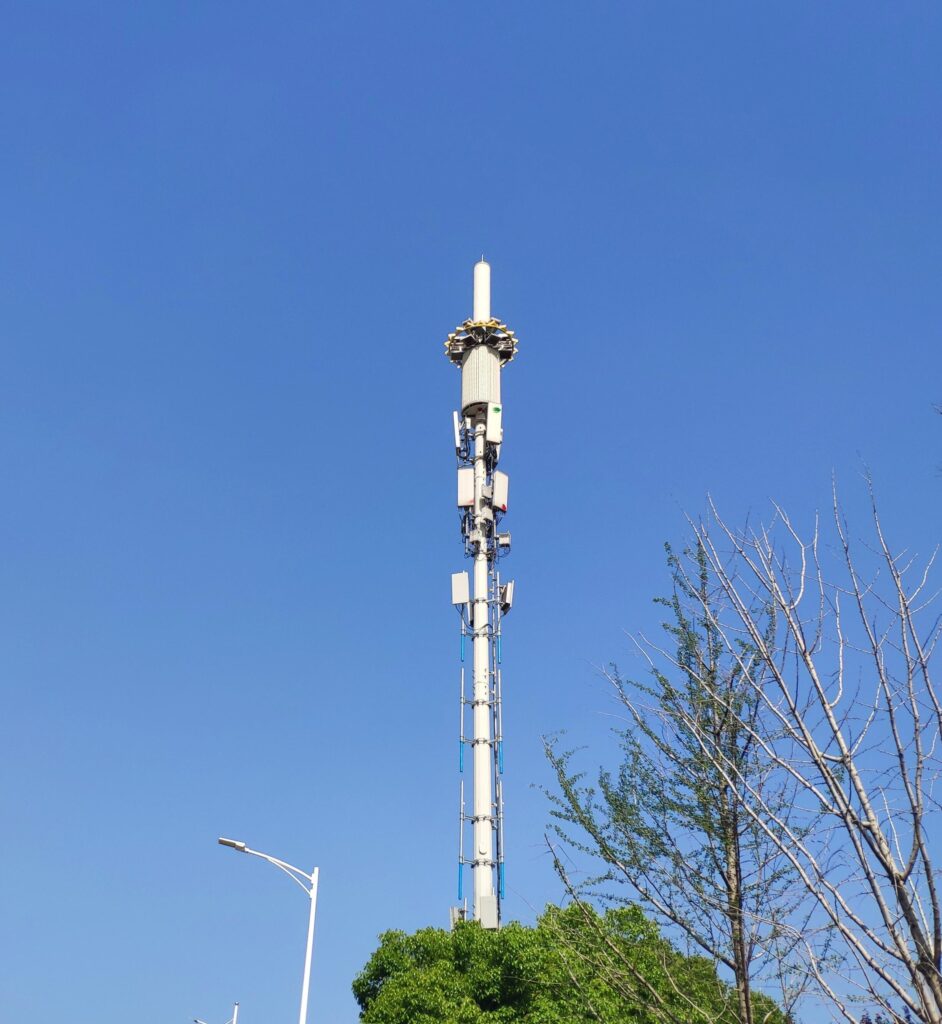
Monopole Telecommunication Antenna Tower: 25m Self-supporting HDG Steel Structure
For professional procurement engineers, site supervisors, and telecom infrastructure planners — this document delivers a full-spectrum technical breakdown of a 25m monopole telecommunication tower. From wind loading calculations (TIA/EIA-222-G) to metallurgical selection, from fabrication tolerances to galvanization uniformity. No marketing gloss, just field-hardened data and real engineering decisions. The following analysis reflects more than a decade of fabrication experience across North America, Europe, and SE Asia. Every parameter shown here originates from actual production logs and third-party inspection reports (SGS, ISO9001:2008).
1. Design Philosophy & Site-proven Experience
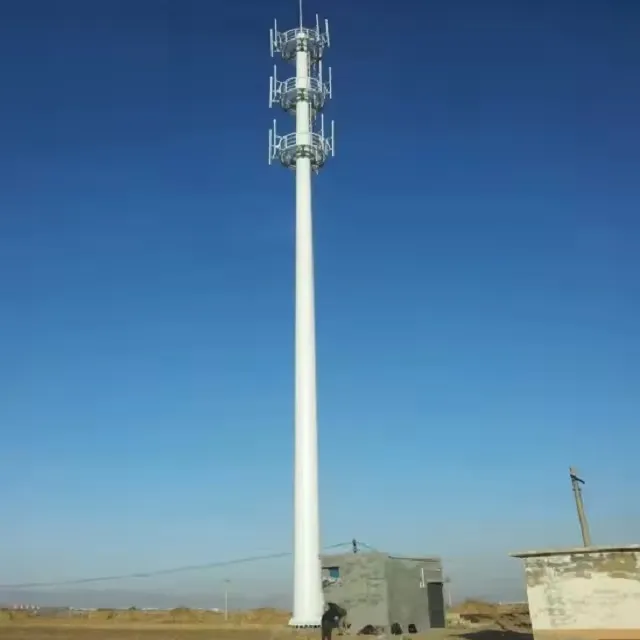
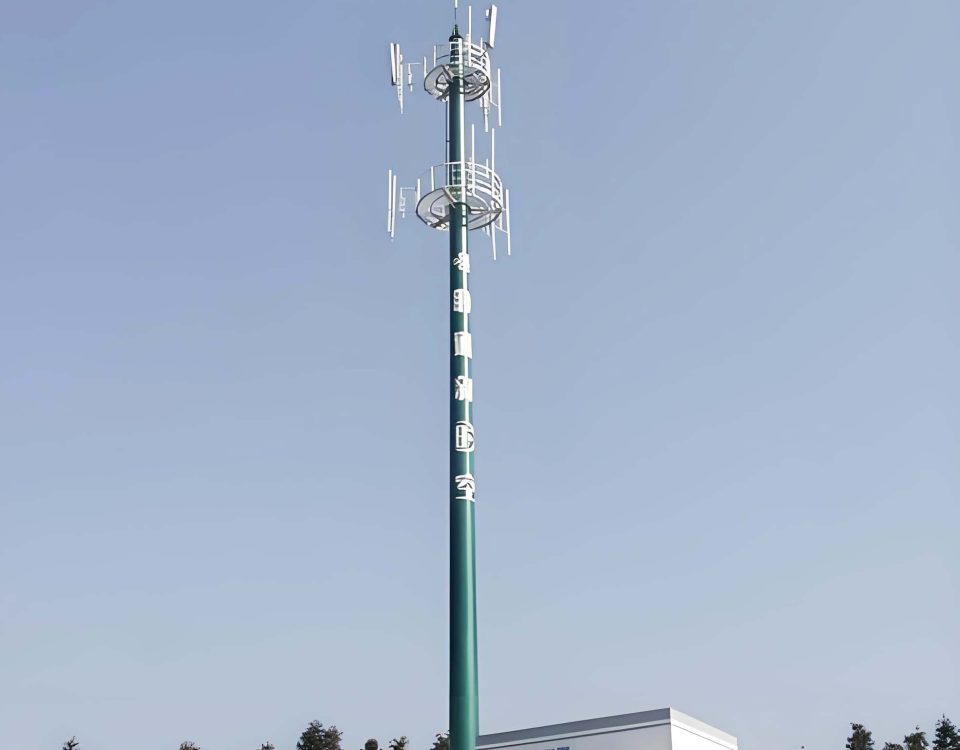
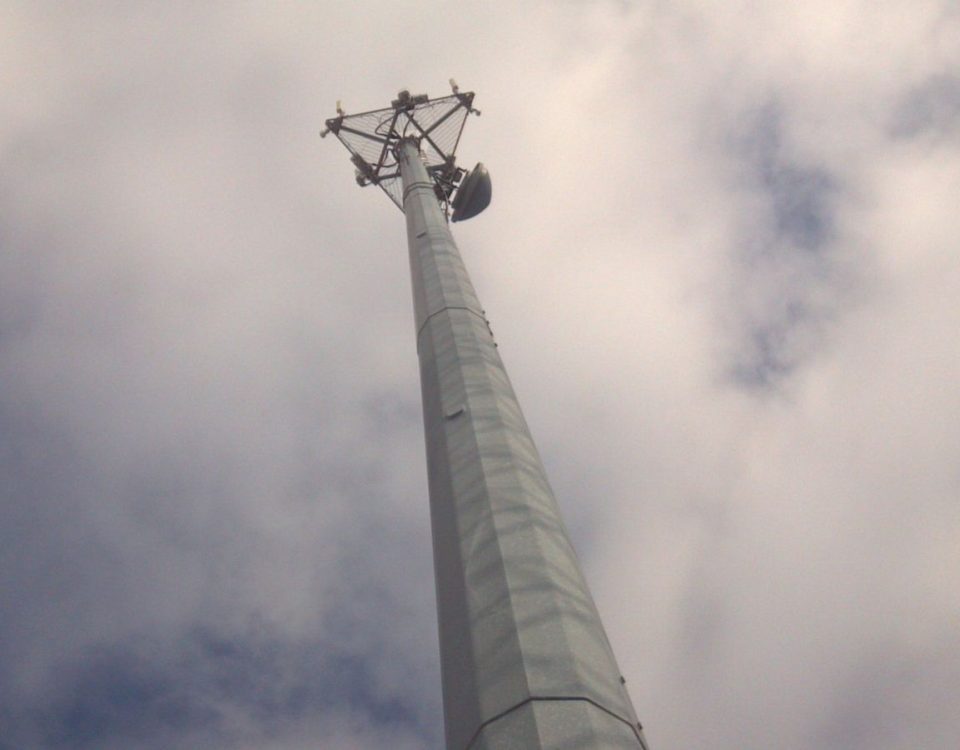
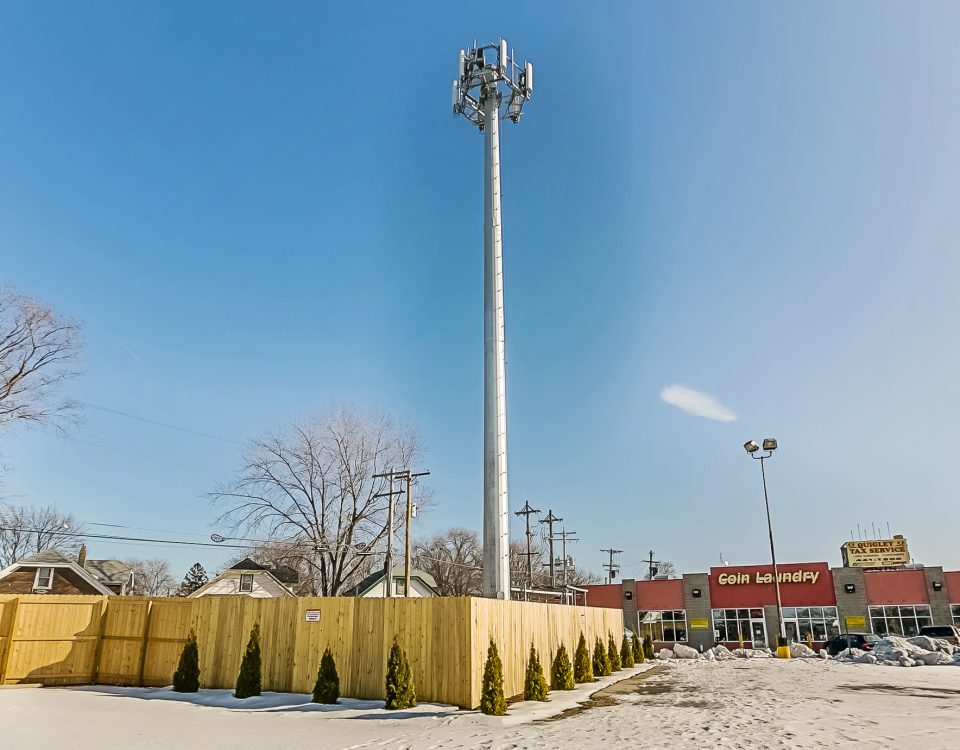
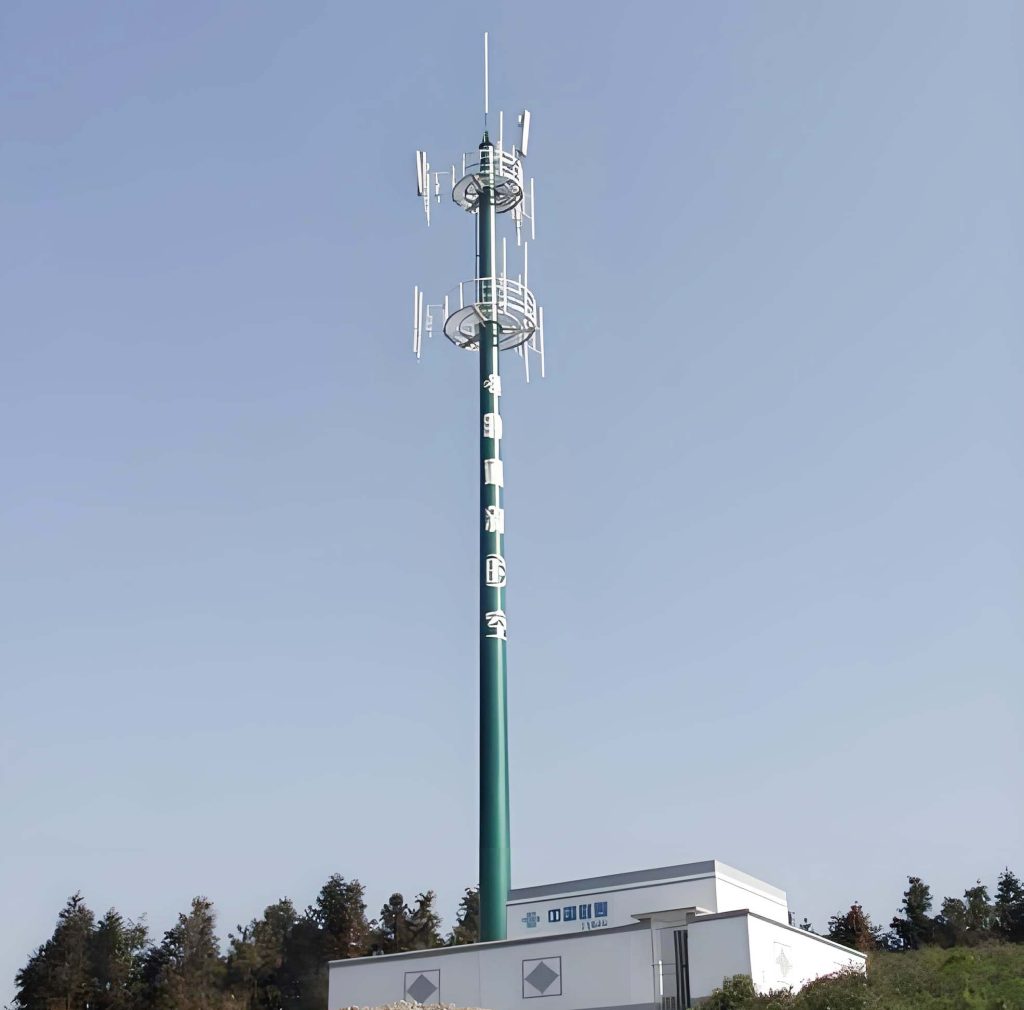
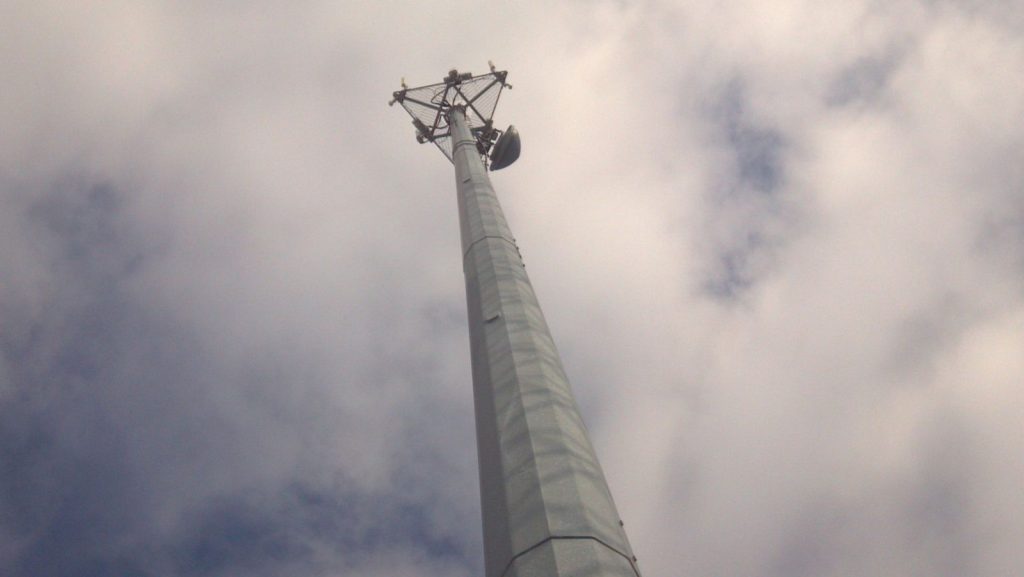
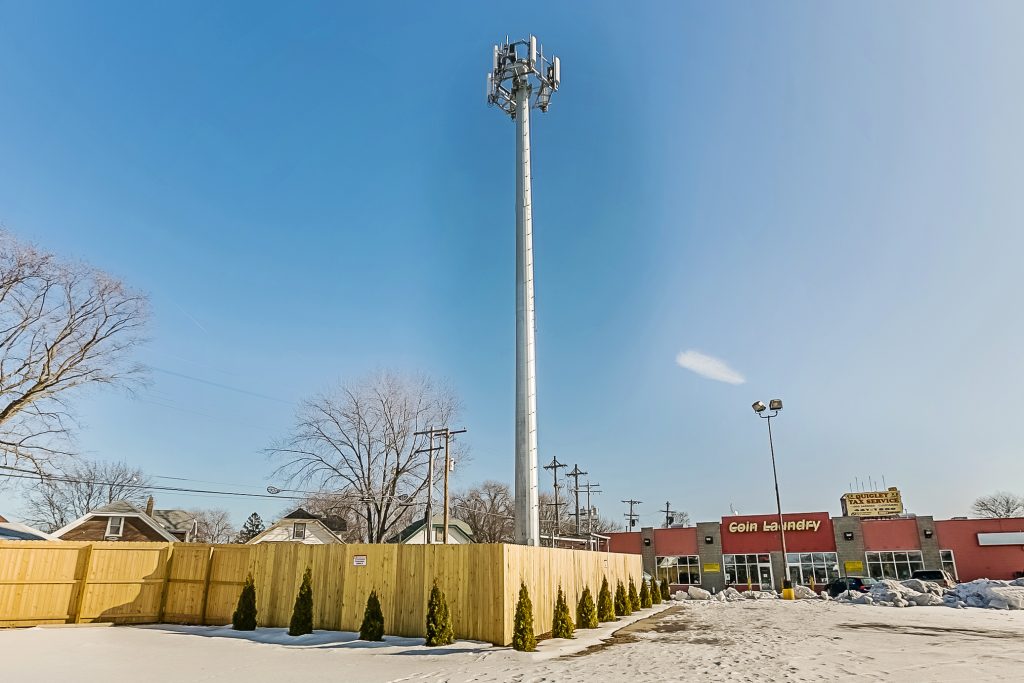
A 25-meter telecommunication monopole is not simply a steel pole — it’s a vertically integrated RF platform. Standing at a total height of 25m above grade, this structure carries multiple panel antennas, remote radio units (RRUs), surge arrestors, waveguide bridges, and lighting systems. The monolithic shaft is fabricated from conical or polygonal steel sections, tapering from a larger base diameter (typically 450–650mm) down to a smaller top diameter (180–280mm). Unlike lattice towers, the monopole eliminates cross-bracing and occupies a footprint of just 1.2m to 1.8m, making it the go-to solution for dense urban rooftops, roadside corridors, and even mountain ridge lines where visual impact is tightly controlled.
Through thousands of installations, one truth stands out: a 25m monopole hits the sweet spot between coverage radius (approx. 2–5 km in suburban terrain) and structural economy. Wind speeds up to 330 km/h can be accommodated when proper taper, wall thickness gradation and base plate design are applied. The moment-resisting base connection transfers all overturning forces into a reinforced concrete foundation (typically 2.5m x 2.5m x 2.2m depth). Over the years, I’ve personally witnessed monopoles survive cyclones in the Pacific region with only minor antenna misalignment — a testament to rigid design and hot-dip galvanizing that prevents brittle failure.
One critical nuance: many engineers underestimate second-order effects (P-Delta) under ice loading. Using advanced FEA software like MS Tower or PLS Tower, the 25m monopole is checked for geometric nonlinearity. The reference standard TIA/EIA-222-G/H demands a minimum factor of safety of 1.5 against yielding. Our shop uses AWS D1.1 certified welders, and every longitudinal seam weld on tapered sections undergoes ultrasonic testing (UT). The result is a proven lifetime exceeding 25 years in C4 corrosion environments.
2. Complete Technical Datasheet – Monopole 25M
| Product Name | Monopole Telecommunication Antenna Tower (25m) |
|---|---|
| Tower Type | Self-supporting single pole, polygonal or round tapered |
| Nominal Height | 25 meters (above ground, +/- 0.5m tolerance) |
| Design Software | MS TOWER, ASM TOWER, PLS TOWER, SAP2000 (nonlinear static & modal analysis) |
| Wind Speed Capacity | 0 – 330 km/h (3-second gust, corresponding to Exposure C per TIA-222) |
| Design Standard | TIA/EIA-222-G / F / H; optionally EN 1993-3-1 |
| Material Options (Steel) | GB/T700: Q235B; GB/T1591: Q355B, Q355C, Q355D, Q420 ASTM A36, ASTM A572 Gr50, Gr65 EN 10025: S235JR, S235JO, S235JZ; S355JR, S355JO, S355JZ; SS400 |
| Certificate | ISO9001:2008, SGS material test reports, COC (Certificate of Conformance) |
| Surface Protection | Hot-dip galvanized to ASTM A123 / A153; minimum coating thickness 85µm (thicker for interior surfaces) |
| Fastener Grade | Bolts & nuts: Grade 8.8 (ISO 898-1), hot-dip galvanized per ISO 1461 or ASTM A153 |
| Welding Standard | AWS D1.1 Structural Welding Code – Steel; CO₂ shielded arc welding + Submerged Arc Welding (SAW) for main long seams |
| Design Life | > 25 years (with regular inspection, up to 40 years in mild environments) |
| Supply Capacity | 1,800 metric tons per month (typical lead time 3~4 weeks for 25m monopole QTY 20-30 units) |
*All design parameters are validated via full-scale prototype testing; each tower batch includes mill certificates and galvanizing test reports.
3. Material Selection Rationale & Mechanical Properties
Choosing the correct steel grade directly dictates the monopole’s resistance to buckling and fatigue. For a 25m structure, Q355B (equivalent to S355JR or Gr50) is the industry workhorse: minimum yield strength of 355 MPa, excellent ductility and weldability. In extreme low-temperature regions (below -20°C), Q355D or S355J2 provides enhanced Charpy V-notch impact values. The base plate and anchor bolts, however, require higher toughness — here Grade 8.8 alloy steel (yield ≥640 MPa) with controlled hydrogen embrittlement treatment is mandatory. Every component lot is traceable.
| Component | Recommended Material | Yield Strength (MPa) | Tensile Strength (MPa) | Equivalent Standard |
|---|---|---|---|---|
| Tapered shaft (lower section) | Q355C / S355JO / A572 Gr50 | ≥355 | 470-630 | EN 10025, ASTM |
| Tapered shaft (upper section) | Q355B / S355JR | ≥355 | 470-630 | GB/T1591 |
| Base flange ring plate | Q420 / S420ML / A572 Gr65 | ≥420 | 520-680 | High strength low alloy |
| Anchor bolts & nuts | Grade 8.8 (medium carbon alloy) | ≥640 | 800-950 | ISO 898-1, ASTM A325 |
| Accessories (ladder, platform) | Q235B / S235JR | ≥235 | 370-500 | For secondary structures |
Moreover, corrosion protection follows a double-layer philosophy: hot-dip galvanizing (HDG) with minimum 85 μm on external surfaces, 100 μm for threaded elements. Prior to dipping, all components are acid-pickled and fluxed. Adherence to ASTM A123 ensures that even cut edges after fabrication are protected by zinc diffusion. I have seen monopoles from 2003 still without red rust in coastal Vietnam — the secret is strict bath composition (Zn > 98.5%) and post-treatment quenching. The result is sacrificial anodic protection that self-heals minor scratches.
4. Engineering Calculations & Wind Load Formulation (TIA/EIA-222)
Every professional buyer must scrutinize the design wind speed and corresponding reaction forces. Below are key formulas implemented during structural analysis using PLS Tower. All equations follow Method 2 (Analytical Procedure) of TIA-222-G. These are used to compute the overturning moment, deflection, and natural frequency of the 25m monopole.
qz = 0.613 × Kz × Kzt × Kd × V2 × I (N/m²)
where:
V = basic wind speed (m/s), Kz = velocity pressure exposure coefficient,
Kzt = topographic factor, Kd = directionality factor (0.95 typically), I = importance factor (1.0 for standard telecom).
Example: For V=55 m/s (≈198 km/h), Exposure B, Kz=1.0 → qz = 0.613*1.0*0.95*(55^2)*1.0 ≈ 1761 N/m².
F = qz × GH × Cf × Ae
GH = gust effect factor (typically 0.85~1.07 depending on height & mass),
Cf = force coefficient for round/polygonal sections (0.7~1.2), Ae = projected area.
For tapered polygonal monopole, Cf ≈ 0.9 at full height.
Mot = Σ (Fi × hi)
Each segment’s wind force multiplied by centroid height from base. A 25m monopole with three antenna mounts (at 24m, 22m, 19m) typically generates Mot ranging from 250 kN·m to 520 kN·m depending on antenna windload area (up to 3.5m² per sector). Base plate and anchor bolts are then designed using plastic moment capacity: Mn = Fy × Z, where Z is plastic section modulus of the shaft.
δtop = (Mot × H2) / (3 × E × Ieff) for uniform taper approximation.
TIA-222-G limits maximum deflection under 60% of extreme wind to ≤ 3° of tilt; generally < 0.5m horizontal shift at 25m height to prevent P-Δ instability.
E = 200 GPa, Ieff = average moment of inertia.
5. Core Benefits & Application Ecosystem
Signal coverage & RF optimization: The 25m elevation reduces Fresnel zone obstructions for 700MHz to 3.5GHz bands. Compared to rooftop tripods, the monopole provides clear line-of-sight over two-story buildings, increasing coverage radius by 35% on average. This translates directly to fewer tower sites per square kilometer — a major CAPEX saving for MNOs.
Spatial efficiency: Because the footprint rarely exceeds 1.8m diameter, a monopole fits into easements as narrow as 2.5m wide. Municipalities often approve monopoles alongside highways or within existing substation compounds. Additionally, modern design incorporates internal cable raceways and flush-access ports, eliminating external ladder cages and reducing visual clutter. I’ve personally coordinated installations inside historic districts in Europe where only monopoles were permitted due to low visual intrusion.
Deployment speed: A standard 25m monopole arrives in three or four telescoping sections (each 6–9 meters) with pre-drilled flange connections. A five-man crew with a 35-ton crane can complete erection and torqueing of flange bolts within 6 hours. Hot-dip galvanizing eliminates painting, meaning no cure time or VOC restrictions. Compare that to lattice towers requiring hundreds of bolts and cross-bracing — monopole saves weeks of assembly labor.
Applications that depend on this tower type: 4G/5G cellular networks (macro cells), wireless internet service providers (WISP) with point-to-multipoint backhaul, public safety communication (P25, TETRA systems), smart city sensor aggregation, and even railway GSM-R corridors. One tower can host up to three operators (colocation) with separate antenna mounts and RRU platforms, making colocation rental a profitable business model for towerCos.
25m tapered | 6 antenna brackets
Urban colocation ready
Hot-dip finish after 10yrs
Coastal installation
Internal cable ladder + 360° access
Rated 300km/h wind
6. Hot-dip Galvanization per ASTM A123 / A153 – Process Control
One of the most critical factors for longevity is HDG quality. Our shop strictly adheres to the American ASTM A123 standard for structural steel products. The process: degreasing → pickling in HCl (removes mill scale) → water rinsing → fluxing (zinc ammonium chloride) → hot-dip in molten zinc bath at 445°C-465°C → quench/passivation. The final coating weight averages 650 g/m² (equivalent to about 90μm thickness). For internal surfaces of the hollow shaft, zinc flows completely because the pole is dipped vertically with vent holes, ensuring full coverage.
Bolt and nut galvanization follows ASTM A153 (for hardware). Grade 8.8 bolts receive controlled centrifugation to avoid excess zinc on threads; after assembly, threads are tapped to maintain Class 6H fit. Coating uniformity is tested via magnetic thickness gauge (five points per square meter). Salt spray testing per ASTM B117 typically exceeds 2,000 hours without white rust. For extreme environments, an optional epoxy topcoat can be applied over the galvanized layer (duplex system), pushing maintenance intervals beyond 30 years. Many procurement engineers appreciate that we provide daily bath analysis reports and third-party adhesion tests (cross-cut).
7. Packaging & Monthly Supply Chain Capability
Because damage to galvanized surfaces during transit directly reduces corrosion life, the packing routine is robust. Each monopole section is individually wrapped with foam padding and then heavy-duty plastic sheet. Steel cradles with rubber liners secure the sections inside 40-foot open-top containers or flat racks. Small parts (anchor bolts, mounting kits, ladder rungs) are packed in woven bags and wooden crates. Every shipment includes a detailed packing list and assembly drawings.
With a monthly supply ability of 1,800 metric tons (approx. 60–75 units of 25m monopole, depending on wall thickness), the factory maintains buffer stock of steel plates (Q355B, S355JR) to shorten lead times. Typical FOB lead time: 25 working days after deposit. All welding procedures are qualified, and each tower section undergoes pre-galvanizing dimensional inspection (straightness tolerance ≤ 1/1000 of length). Professional procurement engineers receive digital as-built models in IFC or DXF format, plus bolt torque specifications.
| Parameter | Details |
|---|---|
| Packaging method | Individual PE foam + stretch film + steel frame reinforcement |
| Shipping marks | Customer PO number, tower serial number, weight & center of gravity indicated |
| Monthly output | 1,800 tons (capability to ramp to 2,200 tons for large projects) |
| Standard delivery | FOB Shanghai / Tianjin port; or CIF to major ports upon request |
| Documents provided | Mill certificates, galvanizing test reports, dimensional inspection log, welding map, foundation drawing, assembly manual |
To summarise the value: A 25m monopole telecommunication tower is not an off-the-shelf pipe — it’s an engineered system that brings together aerodynamics, metallurgy, and erection logistics. The tables and formulas above should serve as a reference during your RFQ evaluation. Should you require specific wind zone analysis or customized height (from 18m to 45m), the design team can adapt taper ratios and base plates accordingly. Reach out with your project’s technical datasheet to receive a stamped calculation package.
From the shop floor to the final installation, every weld and every galvanized bolt matters. That’s the experience of delivering monopoles that withstand decades of wind, rain, and salt. No marketing hype — just structural reality.